Showing posts with label contemporary. Show all posts

Sunday, 30 October 2016

Abstract Expressionism at the RA


 When I have mentioned to friends and colleagues that I went to this exhibition, I have generally been met with a kind of rabbit-in-the-headlights look somewhere between fear and bafflement. If you're not familiar with contemporary art it might sound a bit highbrow but please, PLEASE don't let that put you off; you absolutely do not need to be any kind of expert to go and to enjoy it (exhibit A, my good self). Perhaps more than any other kind of art, it is all about feeling, not knowing. However, if some kind of definition helps . . .

What is Abstract Expressionism (or Ab Ex to its friends)? Well, if we agree that abstract art is generally art that is not 'representative' - i.e. is not a 'representation', or copy, of something in the outside world - and that expressionism is about expressing your thoughts, feelings and ideas - then I guess a reasonable working definition would be that Abstract Expressionists aim to communicate something from the artist's inner world without necessarily using anything in the external world to do this. (Apologies to all the art historians out there who are currently doing a very good impression of Munch's Scream, but hey, it works for me.)

Actually, there are those who would argue that Abstract Expressionism is not a movement or group at all - primarily, most of the artists within it. Rothko famously stated, 'I am not an abstractionist. I'm not interested in relationships of colour or form or anything else. I'm interested only in expressing basic human emotions: tragedy, ecstasy, doom and so on'. The paintings don't really share a particular style; in fact, the canvasses are so full of spontaneity and individuality that apparently the CIA covertly funded Abstract Expressionist exhibitions during the Cold War as an act of propaganda, to lure intellectuals and artists away from Communism by comparing the freedom of these deeply subjective works with the the rigid confines limiting creativity under Soviet rules.

However, the term has stuck as a useful way of referring to a group of artists working in New York in the 1940s and 50s. This period just after the Second World War was, as you might expect, a time of freedom and release, of great explosive energy and creativity, of jazz and Jack Kerouac. One of the comments I found most interesting on the audio guide was about Jackson Pollock and the physical act of creating the works, sometimes called 'gesture' or 'action' painting; it did not just involve the wrist and hand, like traditional painting, but the whole arm - even the whole body; expansive, sweeping movements, requiring a completely different energy and control. Also, suddenly the artist was not standing still in front of a vertical canvas but moving around above a horizontal one; in Blue Poles, paint was dropped from up to two feet above the canvas.

Another common factor you will notice is the scale of the canvasses. Pollock was commissioned to paint Mural for the entrance hall of Peggy Guggenheim's Manhattan townhouse; this was his largest canvas to date and was followed by both Rothko and Gorky producing their largest works the following year. The temptation when viewing it is to stand back and look at the whole painting from a distance, but it was always meant to be seen up close, in a relatively confined space compared to a gallery. Viewing it like this you both appreciate the detail and feel almost engulfed by it, drawn into the energy.

At the heart of the exhibition, in the Central room, are the Rothkos. I will always have a special place in my heart for Rothko and these gorgeous, hypnotic, melancholy paintings; years ago, being taken to the Seagram Murals room in the Tate Modern was a revelatory experience for me and sparked my love of contemporary art. For me, in this exhibition, it was No 15 (Dark Greens on Blue with Green Band) 1957 that drew me in and kept me standing there; somehow, once you stop trying to rationalise them, they connect with you in a way I can't explain but which fascinates me. Luminous, intense and captivating, no print or photograph will ever be able to do them justice.

One of the unexpected gifts of this exhibition was the work of Clyfford Still, an artist I wasn't familiar with before this. In my defence, Still rejected the commercialism of the art world (a pet hate of Rothko's too) and moved to a farm in Maryland, selling hardly any of his paintings; 95% of his work is in a museum dedicated to him in Denver, Colorado and this is one of the few times they have loaned it out. I'm very glad they did, as they are powerful and striking pieces, again designed to actively involve the viewer.

So, even if you think you're not into abstract art, go to this exhibition. Go on your own so you don't have to react in any particular way, and go with an open mind. Don't worry about understanding them, don't try to define what they are about, or of; just stand, look and wait.


Yours, enthralled all over again,

London Girl About Town xx


Wednesday, 29 August 2012

Mr Brainwash

The Old Sorting Office on New Oxford Street (just along the road from the British Museum) is currently hosting the second London exhibition by film-maker turned street artist Mr Brainwash. You can't miss it; the outside of the building features giant images of the Beatles in bandanas, Kate Moss, and the Queen next to the graffitied slogan "God save the People', pink paintbrush in hand.

Mr Brainwash, aka MBW, aka Thierry Guetta first came to the notice of the general public in Banksy's Oscar-nominated 2010 documentary (mockumentary?) Exit Through the Gift Shop, where he is encouraged by Banksy and Shepard Fairey (of Obama Hope fame) to swap film-making for art.
Opinion has been divided since then as to whether MBW is a Banksy hoax, a late developer or an indictment of hype and gullibility in the art world. Either way, Mr Brainwash has since designed an album cover for Madonna, sold over a million dollars' worth of work in his debut exhibition and had work auctioned at Sotheby's alongside that of Andy Warhol.


So is Mr Brainwash nothing but a huge practical joke, a flipped finger to the world of art? You can get quite Dan Brown about the possible clues if you look for them. The name Brainwash itself . . . labels on the giant paint cans in the exhibition boast 'Improved hiding for better coverage' . . . Banksy's iconic rioter is pictured throwing not flowers but a copy of 'Street Art for Dummies' . . .

The portrait of a brooding Banksy (don't get excited, his face is hidden by a hood) in a Van Gogh-inspired room, ironically an artist whose talent is without question but who sold only one painting during his lifetime . . . hmmm. Also when you leave the exhibition you have to walk either to the left or right side of a rope, one marked 'Exit' and one marked 'Free gift'. Those who wandered down the exit only side and then asked for a free poster were told to go back and walk on the correct side of the rope . . . i.e. to Exit Through the Gift Shop.

Or perhaps Mr Brainwash just is who he is and what may have started as a prank has snowballed itself into reality. Interviewers have commented on how genuine he seems, how the exuberance and optimism of his work appear to be an outpouring of his own irrepressible personality. He describes himself as Banksy's 'biggest work of art' and in an interview published in the Evening Standard said 'Banksy pushed me to what I am today . . . but he didn't know that I was going to run and run!' http://www.standard.co.uk/lifestyle/london-life/meet-mr-brainwash-the-street-artist-taking-over-london-7956384.html


So if he is a Banksy creation - intentionally or otherwise - in going to see a Mr Brainwash exhibition, are you actually going to see Banksy? For his part, Banksy has made him a coat which reads 'Mr Brainwash is a phenomenon. I don't say that in a good way.' and Shepard Fairey has said, 'It was fascinating to observe a lot of suckers buying in to his show'. Confused? I think I need a lie down and a large gin and tonic (not necessarily in that order).


Anyway, back to the exhibition. Mr Brainwash's work has been described as 'happy art' and it is certainly that. Whilst it lacks the scathing social comment that makes much of Banksy's work so compelling, it is undeniably enjoyable; the serious, sober-suited security guard said that the exhibition had had over 2,000 visitors per day and certainly everyone there on my visit was having fun. The atmosphere was very relaxed; once past a cursory bag check (I was allowed to keep my bottle of water, they were more worried about pens, paint or crayons) you just wander around the exhibits, taking photos on your phone, chatting and pointing out new finds.

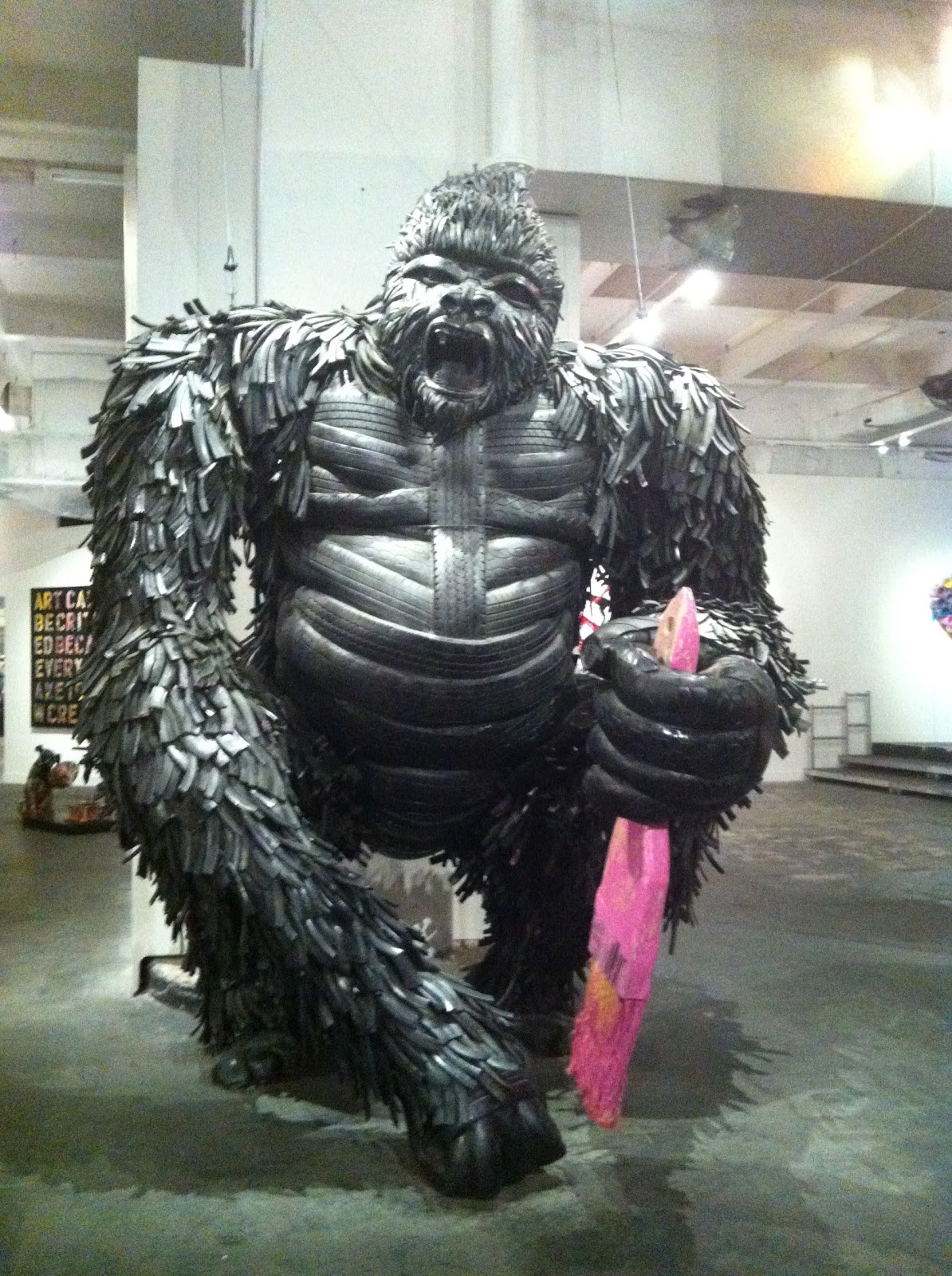
Pose next to a life-sized London black cab in a giant souvenir toy box, Mickey Mouse fashioned out of antique Coke signs or a 20ft gorilla made of rubber tyres, wielding the ubiquitous pink paintbrush. There are pop icons aplenty from Elvis to Elton; I particularly liked the series of music icons incorporating broken vinyl records (although some photographers of the original images are suing).

Th exhibition is free, runs from 1pm (not 11am as mentioned in Time Out) and has been extended until 7th September.
http://www.mrbrainwash.com/
Is it entertaining? Absolutely. Is it art? I have no idea - ask Banksy.


Yours,
Girl About Town xx

Monday, 20 August 2012

Saatchi Gallery: Korean Eye 2012

The Saatchi Gallery is in the beautiful and perfectly proportioned Duke of York HQ building on the King's Road in Chelsea, less than five minutes' walk from Sloane Square tube, and entry is free. Membership to the gallery is also free and gets you invites to special events, talks and members' evenings as well as advance notice of exhibitions; get proactive and sign up in the online room on the second floor.

Korean Eye is the largest exhibition of new Korean art to date and the first time these artists have been shown as a group. Thirty-three artists were chosen from around two thousand applicants, providing a huge range of influences and styles in the works on show. Here are some of my snippets, pictures and highlights but I strongly recommend you go and wander round yourself and make your own choices (by the way, the gallery is fiercely air-conditioned - bliss on the muggy day I went, but you might want a warmish top).


I found shapes crafted from the porcelain deliberately broken and discarded by ceramic masters when the finished piece is not up to standard; Yeesookyung has taken these unwanted, destroyed pieces and made them into something new and desirable, covering the joins with gold leaf.


One room shows huge pictures with embedded photographs on acrylic like holograms that change as you walk past; people (and clothes) appear and disappear, details change, your interpretation of the work alters.


I loved the mesmerising portrait of an elderly Mother Theresa by Hyung Koo Kang painted in oils on aluminium, and pictures of braided hair painted using a single-haired brush.


Huge, photo-realistic pictures of cacti by Lee Kwang-Ho flank a delicate latticed sculpture in one room, and a selection of vases atop packing crates in another.


Cho Duck Hyun's apparently traditional portraits force their way into the present and trail fabric over the gallery floor, contrasting with Kim Buyoungho's wall-mounted bursts of twigs or aluminium.


The lower floor houses 20:50, a site-specific installation by British sculptor Richard Wilson and my favourite piece in a very rewarding visit. The viewer looks down on the piece from a gallery on to what appears to be a drop of several feet and white rectangles on the floor. As a fan of - but no expert in - contemporary art, I dutifully kept looking and awaiting enlightenment; it was the distinct smell of oil that dropped the penny for me.

The rectangles on the floor were in fact reflections of the ceiling lights, there was only one row of windows, not two. In one of the moments I love in art, when you suddenly have to reassess everything you thought you were looking at, I realised that there was an almost impossibly smooth reflective surface over the whole room, and that it was one of the least glamorous (Chris Ofili aside) substances possible; used sump oil. Deceptively simple, disorienting, genius.

Really, go. If you like contemporary art, I'm betting at least one thing there will make you catch your breath.


Yours, impressed,
Girl About Town xx

Sunday, 5 August 2012

Gormley at the White Cube, plus a little Cock and Bull

As a fan of contemporary art, Antony Gormley rates as one of my top three living artists; his incredible Blind Light at the Hayward in 2007 is still my favourite exhibition of all time. I also love the White Cube gallery in Hoxton Square; as it says on the tin, it's a very manageable 2000 square feet of pure, clean white space which has hosted the very best of modern British art since opening in April 2000.
http://whitecube.com/

Imagine then, dear reader, my joy at discovering Still Standing, an Antony Gormley exhibition in that very gallery until mid-September. Still Standing features Gormley's familiar body forms, but this time constructed from small rectangular cast-iron blocks. In the White Cube they can be viewed from different perspectives as you walk amongst them, with nothing to interrupt or impose upon your experience. Entry is free- check the website for opening hours.


Friends who may not be that into art and would moan and groan at the prospect of a trip to the Tate or the National can usually be cajoled into ten or fifteen minutes at the White Cube - particularly as there are some fabulous eateries dotted around the area. On this occasion I had a particular venue in mind; the latest venture from top British chef and Midas-touch restaurateur, Mark Hix.
http://www.chickenandsteak.co.uk/

The Tramshed (so-called because it is housed in an utterly gorgeous high-ceilinged building that was once a tramway generating station) is a three-minute stroll away and has been hitting the headlines because of its main course menu. Not because it is too confusing, or esoteric, or self- congratulatory, but because you basically have two options: steak and chips, or chicken and chips. End of. My companion looked quizzically at the menu and said, 'What do you do if you're a vegetarian?' The answer? Eat somewhere else.

Hix's pal Damien Hirst has supplied two specially-commissioned pieces; a vitrine of a cow and a cockerel (entitled, appropriately, Cock and Bull) dominating the main floor, and a huge Cow and Chicken cartoon on the upper section - are you getting the common theme yet?
Hix haters have been rubbing their hands together in schadenfreude-fuelled glee, predicting that Hix has overstepped himself and will come a cropper over Tramshed. I'm not so sure.

On my visit we opted for the chicken, deciding to skip the three-dish starter sharing plate as we had been warned that the chicken could easily feed three people; they were right, it could.  It arrived upright, claws intact and legs theatrically to the sky, topped with a ball of stuffing and surrounded by a mound of chips finished in chicken fat and rosemary. The staff were delightful and happily carved for us (returning at regular intervals rather than carving it all at once so that it didn't get cold) and the chicken itself was delicious; juicy, flavoursome meat under a seasoned crispy skin. We shared a bottle of the Tramshed red, a light lunchtimey red designed to complement both main course options, and didn't have room for dessert. 

Tramshed also has a gallery called Cock 'n' Bull in the basement which I didn't get a chance to visit, but really want to: as well as traditional viewing space they are building a unique library based on the recommendations of experts in given fields - say, Alice Temperley and Jacquetta Wheeler on fashion. This is a really exciting idea and I'm looking forward to following it as it grows.
So, am I coming back to the Tramshed? You betcha. Anywhere that serves food this good, showcases British art, and puts the soap and hand cream in the ladies' loo in squeezy udders instead of boring plastic bottles has my vote. And anyway, I haven't tried the steak.

You can have anything you want, as long as it's cow or chicken. Hix, we salute you.


Yours carnivorously,

Girl About Town xx


Square Meal

Wednesday, 1 August 2012

But is it art? Damien Hirst at the Tate Modern

I give myself the same Christmas present every year; an annual membership (myself plus guest) to the Tate. As a fan of contemporary art this enables me to swan around all four Tates as I choose, taking friends willy-nilly into exhibitions that are otherwise £10-15 per ticket, as often as I like throughout the whole year. And I can then retire to the Members' Room and people-watch until my feet recover. Bargain.

The Damien Hirst exhibition (until 9th September) at the Tate Modern covers over twenty years of the no-longer-quite-so Young British Artist's work, so off I went to take a look.
http://www.tate.org.uk/whats-on/tate-modern/exhibition/damien-hirst

The exhibition opens with the forerunners of his famous Spot paintings; cheerfully-coloured boxes and pans from Hirst's student days. It's like looking at pictures of a celebrity when they were a baby - then in the next room you're straight into the flip side of the Hirst fame coin, mortality and death. A severed cow's head surrounded by flies - themselves living and dying in the (thankfully) enclosed space - dominates the room; not only visually, but get too close and you can smell it. Hirst himself called it 'a nasty piece' that simultaneously pulls you in and pushes you away; somehow it made me think of the people who slow down on the motorway to gawp at an accident on the other side.

Butterflies are major players in the exhibition too: trapped in the paint of limpidly coloured canvases, in circles like the kaleidoscopes of childhood or living out their brief span in In and Out of Love. I feel bad that they will never see a meadow, but I guess I'm supposed to. Butterflies are perfect memento mori I think because they are so extravagantly fragile and beautiful, yet their lives are so brief. I particularly liked Doorways to the Kingdom of Heaven where they are used to make stained glass windows, a backdrop to a statue of an angel half-flayed like an anatomy model.

Those looking for Hirst's famed shark in formaldehyde will be happy - there are two in this exhibition, along with bisected cows and a black sheep. The one that I found most affecting was the Incomplete Truth; a single dove, captured as if in flight, a kind of simple hope and hopelessness mixed together.


For the merely idly curious and/or the seriously skint, For the Love of God (the iconic £50 million diamond-encrusted skull) could be viewed together with a brief explanatory background video, for free in the Turbine Hall. Sadly, this display has since been closed. There was a bit of a queue, but it was worth it; death has never been more beautifully dressed. 
Hirst is frequently attacked as a purveyor of 'con art' - art which is both conceptual and cons people. I don't pretend to be any kind of expert on art; when I go to an exhibition I just wander around and see what happens, and on the whole I enjoyed this one. For those who sneer at his iconic spot paintings and say 'I could have done that', I just smile and say 'But you didn't, did you?' (Of course some would say actually neither did Hirst - but that's another story!)

Try it - you might like it.


Yours thoughtfully,

Girl About Town xx